


 Listen Live
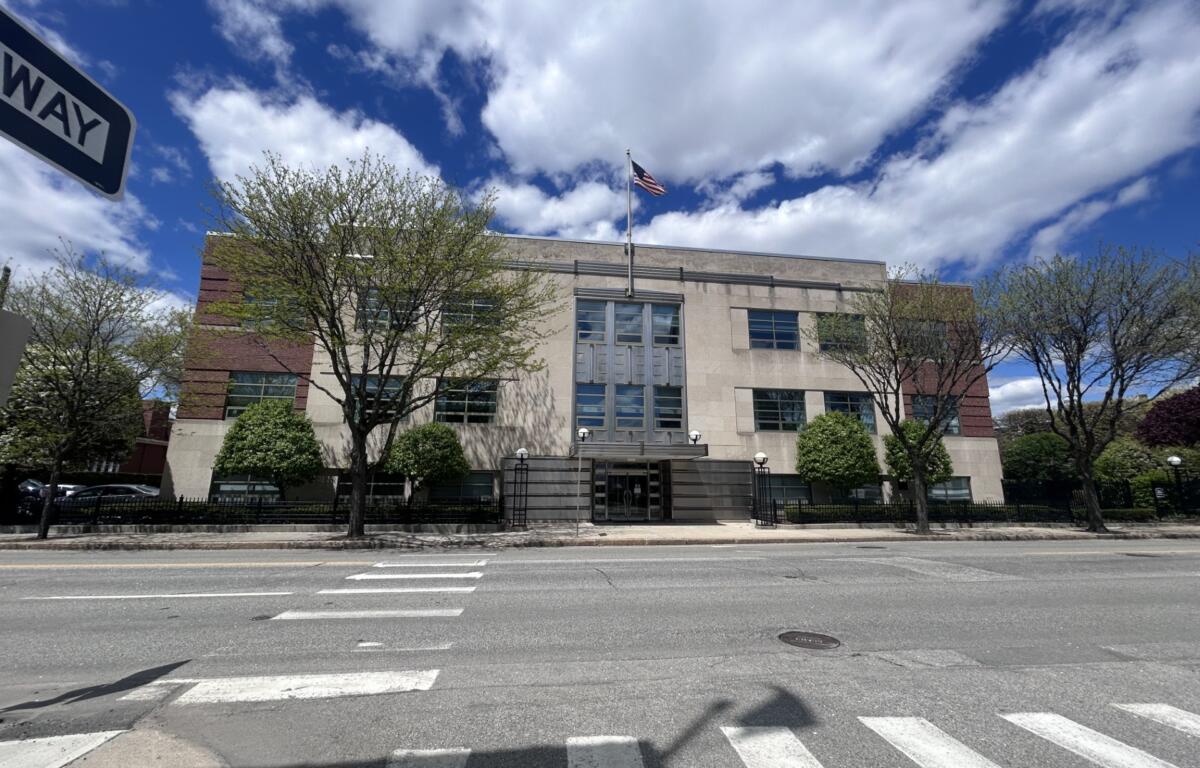

KEENE, N.H. (MyKeeneNow) The recently announced purchase of the former Main Street America Insurance headquarters on West Street could become part of a much larger redevelopment effort stretching from West Street to Gilbo Avenue, according to developer Jack Franks.
Franks, of Avanru Development Group, discussed the property and his broader vision for Keene during a recent appearance on Saturday Morning Live with Randy Filiault on WKBK Radio. Franks is expected to acquire 55 West St. with Manchester developer Dick Anagnost, with the transaction still subject to the completion of due diligence.
The four-story, approximately 130,000-square-foot building was formerly occupied by Main Street America Insurance, which has been relocating employees to 100 West St. as the company reduces its office footprint.
Franks said the quality of the building was a major factor in the decision to pursue the purchase.
“Granite, marble — they spared no expense,” Franks said. “In my humble opinion, you couldn’t build that building today for less than $45 million, maybe closer to $50 million.”
Franks described the property as one of the premier buildings in Keene, but also acknowledged the challenge presented by its size.
“It’s a white elephant,” he said, referring to the difficulty and expense of maintaining such a large building if it is not fully utilized.
Franks said he and his partners were also motivated by a desire to prevent the property from sitting vacant for years.
“We wanted to be able to essentially control that corridor,” Franks said. “We didn’t want somebody coming in to mothball it and let it sit for years.”
Housing And Senior Living Among Options
While no final redevelopment plan has been announced for 55 West St., Franks said housing and senior living are among the possibilities being considered.
He pointed to what he described as a significant shortage of senior housing in Cheshire County. Franks said a recent market study showed an almost eight-year waiting list for senior housing in the area.
“That’s unfathomable,” Franks said, comparing the housing shortage with his own experience trying to get a senior housing project approved in Swanzey
Franks said that 74-unit development took seven and a half years to move through planning and zoning proceedings and involved multiple lawsuits. He estimated that he spent approximately $750,000 in legal fees during the process.
He said the experience has reinforced his determination to pursue housing projects despite regulatory obstacles.
“A lot of developers will just walk away from a deal,” Franks said. “Not me. I’m not wired that way. I’m going to stand for the poor, the disadvantaged, the elderly, and I’m going to make certain that they have an opportunity for a safe place to live.”
Franks also criticized what he described as situations where individual agendas on planning or zoning boards can slow development.
“It generally centers around one or two individuals that are on a zoning or planning board that are there because they have an agenda,” he said. “When you bring emotion into a development project, things get off the rails pretty quickly.”
100 West Street Redevelopment
While the future of 55 West remains under consideration, Franks said work is already underway at 100 West St., the building across the street.
The goal is to rehabilitate the building so Main Street America Insurance can relocate employees there while maintaining its Keene operations.
Franks said preserving those existing jobs is an important part of the redevelopment strategy.
The properties being considered as part of the broader effort include the former insurance headquarters, 100 West St. and associated parking areas, including property near Gilbo Avenue.
A Much Larger Vision For Gilbo Avenue
Franks also discussed a potentially transformative redevelopment of the Gilbo Avenue corridor.
He said he believes the area is one of the most underutilized portions of downtown Keene and that a combination of privately owned and city-owned property could potentially accommodate hundreds of new housing units.
“By my calculations with the parking that we have and the land across the street, we could probably put four or five hundred units down there,” Franks said. “That’s going to be such a huge win for downtown Keene.”
One idea would be to reconfigure or partially close Gilbo Avenue to create a more pedestrian-oriented district similar to Church Street in Burlington, Vermont.
“I think the idea of maybe shutting down part of Gilbo and actually making like a Church Street atmosphere might be something to consider,” Franks said.
Such a concept could combine housing, parking, pedestrian space and ground-floor commercial activity.
Franks acknowledged that parking would be one of the biggest challenges. He said any major expansion of housing would need to be accompanied by a comprehensive parking strategy, potentially including structured parking.
He also emphasized that such a project would require cooperation between developers and the city.
“It takes the city, it takes us, and [we have to] work together collectively to achieve great results,” Franks said.
Modular Construction Could Help Address Housing Costs
A major part of Franks’ development strategy involves modular construction, which he said can significantly reduce construction time and improve energy efficiency.
Franks said his company has worked with Ritz-Craft in Pennsylvania and substantially redesigned its modular construction platform.
The process involves constructing building modules in a factory before transporting and setting them into place with a crane.
Franks said the approach can allow projects to move approximately twice as fast as traditional stick-built construction while reducing costs and improving energy efficiency.
He pointed to a 42,000-square-foot, 42-unit apartment project in Hillsboro as an example. According to Franks, the building was set in place in five days, made watertight within five days and became fully occupiable in about six months.
He also touted the energy performance of the buildings.
“We’re heating apartments 600 or 900 square feet for less than eight-tenths of a gallon of propane per day in the dead of winter,” Franks said.
Much of Franks’ affordable housing work is aimed at households earning 60% of area median income or less. He said the use of tax credits and equity investment allows developers to reduce debt costs and pass those savings along to tenants.
Franks said that can translate into rents that are $300 to $500 per month below comparable market-rate housing.
The target, he said, includes workers earning roughly $20 to $35 per hour who may earn too much to qualify for some forms of assistance but still struggle to find quality housing.
“We’re able to pass those savings directly to the tenant,” Franks said.
Kingsbury Property Could Have Regional Potential
The conversation also turned to the long-troubled Kingsbury property in Keene.
Franks said the property could have significant potential if it becomes available at a realistic price. Among the ideas he raised was a concert or sports venue capable of attracting visitors from New Hampshire, Vermont and northern Massachusetts.
“Why not Keene?” Franks asked. “You’ve got the interstate corridor, 91. You’ve got the entire state of Vermont, Northern Massachusetts.”
He suggested a summer concert venue could benefit hotels, restaurants and other businesses throughout the region.
Franks said projects of that scale could help Keene attract younger residents and strengthen its economic base.
Franks Says Development Is About More Than Profit
Throughout the interview, Franks repeatedly framed his development plans as an effort to address community needs rather than simply generate returns.
“We’re trying to make a difference,” he said. “This isn’t just about us profiting. There are homes that need to be built. There are jobs that need to be created.”
Franks said he intends to continue pursuing housing projects even when they encounter opposition.
“When I’m looking at a housing development, I’m thinking of the single moms, the young couple that can’t afford it,” he said. “When I get pushback from communities that don’t want those people, that irritates me beyond end.”
Franks was joined during the interview by his son, Avery, who is becoming involved in the family development business.
Avery said working alongside his father has provided a broad education in the many aspects of development.
“I think I learn more in a day than I could in an entire year at school,” he said.
For Keene, Franks said the immediate focus remains completing work at 100 West Street and determining the best future use for 55 West. But he said the properties could ultimately become part of a much broader redevelopment of the West Street and Gilbo Avenue corridors.
The concepts discussed on the program remain preliminary, and Franks said any major redevelopment would require further planning, discussions with city officials and resolution of issues including parking, zoning and infrastructure.
Listen to the full interview: