


 Listen Live
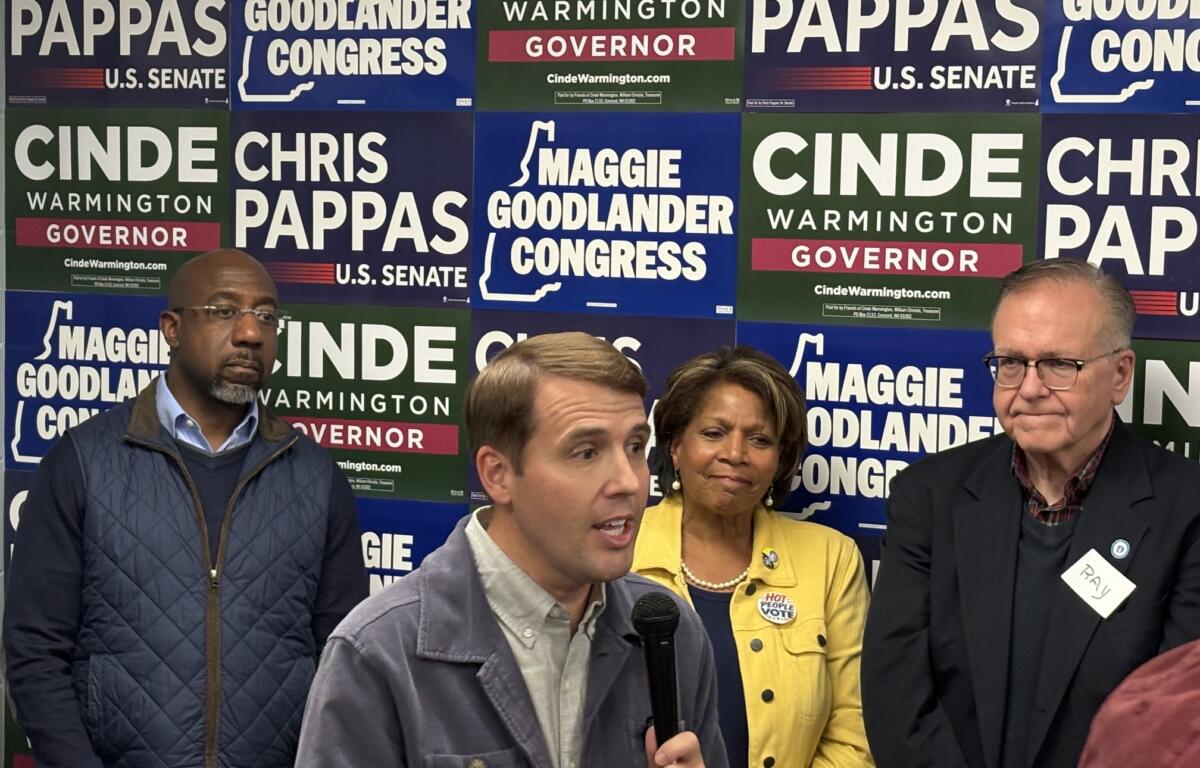

SWANZEY, N.H. (MyKeeneNow) U.S. Rep. Chris Pappas and U.S. Sen. Raphael Warnock of Georgia joined Democratic candidates, party officials and supporters Tuesday evening for the opening of a new Organize New Hampshire campaign office in Swanzey, with speakers urging voters to make the 2026 election a referendum on President Donald Trump’s policies and the direction of the federal government.
The event at 140 Monadnock Highway brought together Pappas, the Democratic nominee for U.S. Senate in New Hampshire; Warnock; New Hampshire Democratic Party Chair Ray Buckley; state Sen. Donovan Fenton; House Democratic Leader Alexis Simpson; and Executive Council candidate Melanie Levesque.
Pappas is challenging Republican former U.S. Sen. John Sununu in the November 3 election for the Senate seat being vacated by Democrat Jeanne Shaheen. Pappas has made opposition to Trump and what he describes as corporate influence in Washington central themes of his campaign.
Warnock: Brokenness Can Create Opening for Demagogues
Warnock, who is a pastor and has represented Georgia in the U.S. Senate since 2021, framed the election in broader terms, arguing that a widespread perception that the country is broken can create an opening for leaders who portray themselves as uniquely capable of fixing it.
He described the condition as a form of spiritual sickness and said demagogues can capitalize on that sense of national frustration by presenting themselves as the only person capable of solving the country’s problems.
Warnock pointed to Trump as an example, arguing that Trump’s political message has portrayed him as uniquely positioned to repair a country he describes as broken.
The senator also criticized Trump’s conduct in office and questioned who has benefited from the economic gains Trump has highlighted.
Warnock called for a new generation of leadership in Washington and argued that the country’s political system should serve ordinary Americans rather than wealthy individuals and corporate interests.
Pappas Makes Case Against Trump-Aligned Policies
Pappas used the event to draw a contrast between his campaign and Sununu, repeatedly linking his Republican opponent to Trump.
Pappas has previously criticized Sununu for accepting Trump’s endorsement and for supporting portions of the president’s agenda. Sununu has said he intends to protect what he considers the administration’s accomplishments while maintaining that he will act independently for New Hampshire.
Pappas said voters have a choice between continuing current federal policies and electing a senator who would oppose them.
Among the priorities he outlined were expanding access to health care, lowering costs, protecting Social Security, Medicare and Medicaid, protecting reproductive rights, addressing climate change, and protecting clean air and water.
He also called for reducing the influence of money in politics, overturning Citizens United v. FEC, and opposing nominees he considers unqualified.
Pappas criticized immigration enforcement policies and proposed or enacted reductions in health and nutrition programs. He also argued against tax policies he said disproportionately benefit wealthy Americans.
Pappas has previously described his Senate campaign as a fight against high costs, corporate special interests and what he calls corruption in Washington.
Attacks on Trump, Sununu and Corporate Interests
Speakers repeatedly criticized what they described as the influence of wealthy donors, corporations and political action committees in New Hampshire and Washington.
Pappas has claimed that Sununu benefited financially after leaving the Senate by working for industries and companies that had interests before Congress. His campaign has specifically cited a figure of up to $35 million in discussing Sununu’s post-Senate income.
Pappas also has criticized Trump’s personal wealth gains while in office. In remarks at an earlier campaign event, he said Trump had increased his net worth by $2.2 billion through stock trades, cryptocurrency-related activity and other business dealings. Those comments were part of Pappas’ broader argument that Trump’s description of a “golden age” does not reflect the economic experience of many New Hampshire residents.
The event also featured criticism of spending by national political organizations and wealthy donors. Speakers argued that millions of dollars being spent in New Hampshire are intended to influence the Senate race and preserve political power.
Republicans have responded by arguing that Pappas’ decision to campaign with Warnock demonstrates his alignment with national Democrats. New Hampshire Republican Party Chairman Scott Maltzie said Tuesday that Pappas’ appearance with Warnock showed voters where Pappas stands on national issues.
Warnock Invokes Civil Rights Movement
Warnock also connected the 2026 election to the history of the civil rights movement, pointing to the work of Dr. Martin Luther King Jr., John Lewis, Hosea Williams and Amelia Boynton during the fight for voting rights.
He said major political changes that are now viewed as historic achievements—including women’s suffrage, civil rights advances and LGBTQ rights—were not inevitable and required people to organize, march, knock on doors and continue showing up.
The message was also applied to the current election, with speakers encouraging supporters to engage voters throughout New Hampshire.
Warnock criticized proposed federal legislation that he said would reduce Medicaid funding, cut health care coverage and reduce Supplemental Nutrition Assistance Program benefits. He connected those concerns to his religious beliefs, saying faith should be reflected in efforts to care for sick and hungry people.
Focus on Voter Turnout
Organizers emphasized voter turnout as a central component of the Democratic campaign heading into the November 3 election.
Speakers pointed to what they described as stronger-than-expected Democratic participation during the primary and argued that similar turnout in November could affect races ranging from the Executive Council and state Legislature to governor, Congress and the U.S. Senate.
The event also introduced local organizers who will work on voter outreach in the Monadnock region, including field organizer Dylan Heller and coordinator Katie Lafazia.
The new Organize New Hampshire office is intended to provide a base for canvassing, phone banking and other campaign activities in the region.
Pappas and Warnock’s New Hampshire appearance was part of a broader campaign swing for the Senate candidate. On Tuesday, they also appeared with local officials and first responders in Manchester, where Pappas discussed federal funding for fire departments and local tax pressures.
The Republican campaign and outside conservative groups criticized Pappas’ decision to campaign with Warnock, arguing that the Georgia senator represents national Democratic priorities that they say are out of step with New Hampshire voters.
The November 3 election will determine who succeeds Shaheen in the U.S. Senate.