


 Listen Live
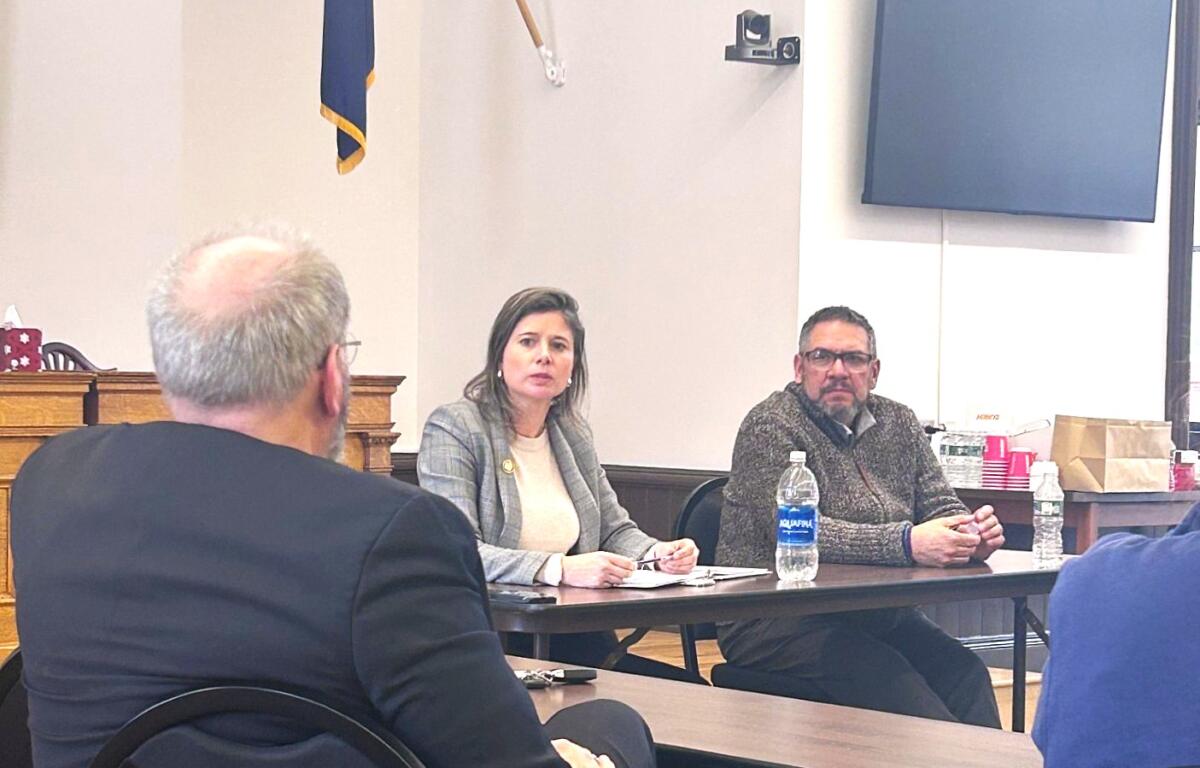

KEENE, N.H. (MyKeeneNow) N.H. Congresswoman Maggie Goodlander met with Cheshire County and local law enforcement leaders at the Cheshire County Courthouse on Wednesday afternoon to detail how $300,000 in federal funding will be used to modernize portable radio equipment for deputies across the region.
The funding, secured through the fiscal year 2026 appropriations process, will allow the Cheshire County Sheriff’s Office to replace 30 aging portable radios. Officials say the upgrade is essential to ensuring deputies can reliably connect to the region’s recently overhauled law enforcement radio communications network.
Cheshire County Sheriff Eli Rivera and County Administrator Chris Coates were joined by area police leaders, including Rindge Police Chief Rachel D. Malynowski and Winchester Police Chief David Rice, to discuss how communication challenges affect day-to-day operations — particularly in rural parts of the county.
Coverage Gaps And Safety Concerns
Law enforcement officials described persistent radio dead zones caused by terrain and tower placement, noting that portable radios operate at significantly lower power than cruiser-mounted systems. That can result in a dangerous scenario: an officer may hear dispatch clearly, but dispatch cannot hear the officer’s response.
Cellular service poses another complication. No single carrier covers all of Cheshire County, forcing deputies in different regions to rely on different providers to maintain workable service. At the same time, departments increasingly depend on cell networks and cloud-based systems for records management software, mobile data terminals, and body camera uploads.
Some agencies have installed vehicle cell boosters — costing several hundred dollars per cruiser — but leaders acknowledged that equipping entire fleets is financially challenging. More advanced solutions, such as cruiser-based repeaters or specialized mobile network systems, carry even higher price tags and face technical hurdles, including limited radio frequency availability.
Officials said the new portable radios funded through Congress will at least ensure compatibility with the updated regional network, improving clarity and interoperability among departments.
Grants And Uncertainty
County leaders emphasized that grants are often the only way smaller departments can afford modern equipment. Mobile radios installed in cruisers can cost around $8,000 apiece, making wholesale upgrades difficult without outside assistance.
The county currently manages dozens of grants totaling roughly $16 million annually, drawn from federal, state, and private sources. However, officials voiced concern that some federal grants — particularly those tied to the U.S. Department of Justice — have recently faced delays and unpredictability, complicating budgeting for items such as protective vests, cell phones, and other equipment.
Participants warned that when previously awarded funds are slowed or reconsidered, it disrupts long-term planning and can increase costs.
A Shrinking Workforce
Beyond technology, much of the discussion centered on staffing shortages affecting both law enforcement and dispatch centers.
Leaders said applicant pools have shrunk dramatically. Where departments once saw dozens of qualified candidates per opening, they now may receive a handful of serious prospects — and sometimes none pass required testing. Competition between agencies has intensified, with larger or better-funded departments offering substantial signing bonuses and higher pay.
Smaller towns operating under tight budgets often cannot match those incentives. As a result, some local agencies have become informal training grounds, losing newly certified officers to departments in larger communities or across state lines.
Officials also pointed to generational shifts. Younger recruits are seen as less inclined to commit to 25- or 30-year careers, particularly in rural regions that may lack the amenities of urban areas.
High turnover and retirements have raised concerns about the loss of institutional knowledge. In some agencies statewide, a significant portion of officers have fewer than five years of experience.
Retirement And Retention
Changes to New Hampshire’s retirement system were cited as another deterrent. Law enforcement leaders said previous pension structures and retiree health benefits once made policing an attractive long-term career. With reduced multipliers and the elimination of certain benefits, the profession has become less competitive compared to neighboring states such as Massachusetts.
Officials argued that stabilizing retirement benefits and ensuring officers can realistically retire without needing second jobs would help improve retention.
Dispatch Under Pressure
The staffing crunch extends to the county dispatch center, where officials described a high-stress environment requiring specialized skills and long hours. The center operates with a small core of full-time dispatchers supplemented by per diem staff and supervisors, but is frequently short-handed or training new hires.
A Regional And Long-Term Issue
Participants compared law enforcement staffing challenges to shortages in healthcare and nursing, framing the issue as part of a broader workforce shift.
They stressed the need for coordinated, long-term planning among local, county, state, and federal partners — and for dependable funding streams to support equipment, benefits, and recruitment efforts.
For Goodlander, the $300,000 radio investment represents a step toward improving officer safety and communication reliability. Local leaders said it is a welcome boost, even as they continue grappling with larger structural challenges facing public safety in Cheshire County.