


 Listen Live
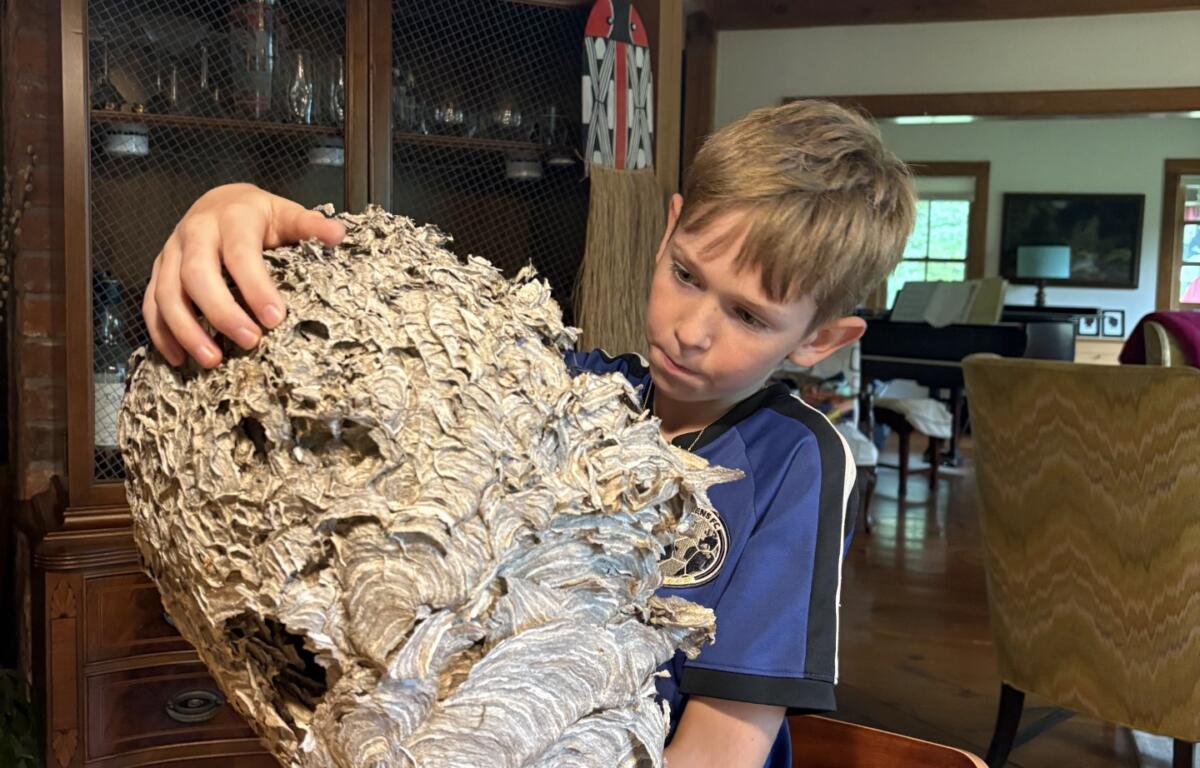

WESTMORELAND, N.H. (MyKeeneNow) Most kids who find a wasp nest would probably do everything they could to stay away from it.
Forest Bell does the opposite.
The Westmoreland boy has spent the past several years developing an unusual fascination with wasps, hornets and the intricate paper nests they build. What began as a COVID-era interest in watching nest-removal videos has grown into a hands-on hobby that now takes him around the Monadnock Region removing active wasp nests — for free.
“I was collecting wasp nests after they had evacuated,” Forest said.
His collection began with abandoned nests gathered around Westmoreland, with help from his parents, Kristin and Alan Bell, and local residents who responded to requests on the town’s Facebook page. People began giving Forrest nests they had found in barns, sheds and other outbuildings, sometimes delivering them to the family in boxes.
Forrest wasn’t simply interested in having the nests. He wanted to understand them.
Some were carefully cut open so he could examine the layers of paper and the honeycomb-like structures inside.
The nests themselves are remarkable pieces of natural engineering. Wasps make them by chewing wood fibers and mixing the material with saliva, creating a paper-like substance. Different sources of wood can give the nests varying shades and patterns.
To Forest, the abandoned structures became something worth studying and preserving.
To his mother, they sometimes look like artwork.
The family has discovered, however, that preserving the nests isn’t easy. New England’s moisture and humidity can cause the fragile structures to absorb water and develop mildew. That hasn’t stopped them from considering creative ways to display them, including the possibility of turning photographs of the collection into an exhibit.
From Watching Videos to Removing Nests
Forest’s interest took a more practical turn during the pandemic, when he began watching videos from the YouTube channel Hornet King. The videos showed nest removals using a wet-dry shop vacuum, soap and water.
Eventually, Forrest decided he wanted to try it himself.
Last year, he announced to his family that he wanted to start a pest-control business. The idea evolved into something a little different.
With help from his mother, Forest created flyers and posted them around Westmoreland, including at the Westmoreland General Store.
The message was simple: free wasp removal.
Kristen is quick to clarify that Forest isn’t operating a formal pest-control company. The flyers describe the work as free, and the family handles the logistics and communication with customers.
When people call the number on the flyer, they reach Kristin. She makes sure they know exactly who will be showing up.
“When the guy called me — because it’s my phone number on the flyer — he’s like, ‘Yeah, I’m interested in the wasp nest removal one.’ I said, ‘Full disclosure, it’s my 11-year-old son. Are you okay with that?’”
The first customer was a local jewelry store owner.
Then came a job that put Forrest’s unusual hobby in front of a much larger audience.
A Wasp Nest at the Bike Park
Forest was called to the Keene Bike Park, where a ground nest had become a problem.
Michael Davern, who helps with the park, asked Forest to take care of it and suggested documenting the work with photographs.
The pictures were shared online, and the response was immediate.
The post generated significant attention and quickly led to more people contacting the family about nests on their own properties.
It also introduced Forest to one of the less glamorous realities of his new hobby: not every job comes with an electrical outlet.
The bike park had no convenient source of power, so the family brought along a generator to run Forest’s shop vacuum.
That has become part of the equipment list depending on the location — along with extension cords, the wet-dry vacuum and whatever tools are needed to expose the nest.
Forest’s method is straightforward. Rather than simply spraying a nest with pesticide, he uses the vacuum to remove the active wasps.
“The actual wasps,” he explained when asked what he was vacuuming. “You’re sucking them up into the vacuum.”
The work can become considerably more complicated when the nest is underground.
At one Swanzey property, Forrest encountered a ground nest with wasps emerging from multiple openings. Instead of immediately digging into the ground, he changed his approach.
“I started just scraping away the brush because it’s much easier,” he said. “Then I like dig out the whole spot so I can just lift the whole nest out.”
Experience has taught him which nests he prefers.
“I like the bald-face white ones,” Forrest said.
One reason is that they tend to have a more obvious entrance, making the job easier to manage.
More Than Just a Hobby
Forest has picked up an impressive amount of information about the insects he’s working around.
One of his favorite facts is that bald-faced hornets aren’t actually hornets.
Despite their common name, bald-faced hornets are a type of wasp. The European hornet is the true hornet commonly established in New England.
Forest can talk about colony behavior, queens, late-season aggression and the various creatures that can inhabit a nest. During one removal, he found evidence of tiny parasitic wasps that had laid eggs in the larvae.
The more he learns, the more the hobby appears to be moving beyond simple curiosity.
But there is one aspect of wasp removal that Forest has had to learn the hard way: wasps sting.
He has been stung, but it hasn’t discouraged him.
His calmness around the insects has even rubbed off on his mother.
Kristin said watching her son work has made her less nervous around wasps herself.
For customers, however, the insects can be a much bigger problem.
Nests near porches, sheds, pools and other frequently used areas can effectively make parts of a property off-limits. Some customers have told the family they felt as though they were being “held hostage” by a nest.
Once Forrest removes it, that changes.
“Everybody’s been really gracious and grateful,” Kristin said, describing customers who are suddenly able to use their yards and outdoor spaces again.
Free Doesn’t Mean it Costs Nothing
Although Forrest doesn’t charge for the removals, customers often offer him tips.
Most are in the $20 to $25 range.
The largest so far?
$100.
Forest has put some of that money back into his hobby. His parents had him purchase his own wet-dry shop vacuum, which cost about $130, rather than relying entirely on the family’s equipment.
He’s also learning some of the less exciting parts of running a service.
Kristin has started making him keep a customer log, recording who called, where the job was and what happened.
The idea is to give him a record to work from next season, especially as repeat customers begin calling.
It also means he can look back and remember a particular property and the challenges he encountered there.
Forest already has repeat customers, including some of his earliest clients.
And while he has the equipment, the customers and the experience, there is still one thing his operation doesn’t have: a paid driver.
His father, Alan, handles that job.
“So far, I drive him to all these jobs,” Alan joked. “He never tips me.”
From Wasps to Bees
Forest’s interest in stinging insects isn’t limited to wasps.
Next spring, he plans to become a beekeeper.
The family had hoped to start this year, but illness caused them to miss a beekeeping course. They’ve already begun preparing for next season, though, purchasing hive boxes and other equipment from Betterbee in New York.
Forest has also spent time with local beekeeper Peter Hills, learning about hives, honeycomb, wax and propolis.
The plan is to continue both hobbies.
“Going to do it all,” Forest said when asked whether beekeeping would replace nest removal.
For now, that means Forest is likely to remain the kid people call when an unwanted wasp nest turns an otherwise usable part of their property into a no-go zone.
What started with YouTube videos during COVID has become something much more unusual: a young person’s fascination turned into a practical skill, a community service and perhaps the beginning of a lifelong interest in insects.
And somewhere along the way, the wasp nests themselves became more than something to remove.
Forrest sees them as something worth understanding.