


 Listen Live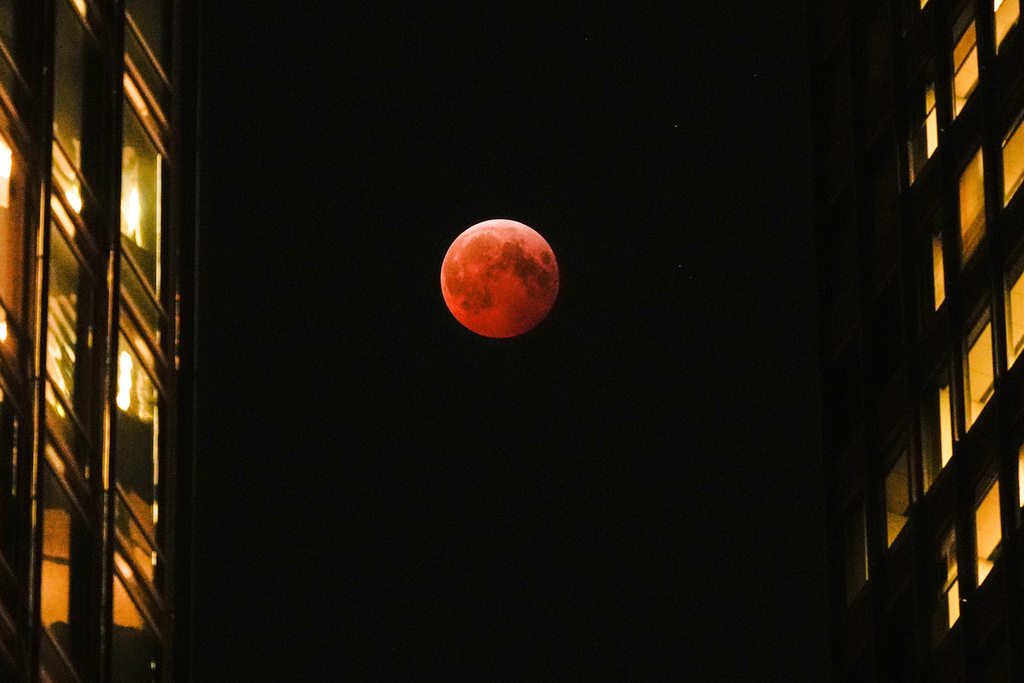

MONADNOCK REGION, N.H. (MyKeeneNow) If you’re willing to brave the cold before sunrise Tuesday, March 3, a total lunar eclipse will briefly paint the Moon a deep red over New Hampshire and the rest of North America.
Here’s what you need to know.
How A Lunar Eclipse Works
A lunar eclipse happens when Earth moves directly between the Sun and the Moon during a full Moon phase. As Earth blocks sunlight, it casts a large shadow across the lunar surface.
The reddish color — often called a “blood Moon” — appears because sunlight passing through Earth’s atmosphere is filtered and bent toward the Moon. The atmosphere scatters shorter blue wavelengths and allows more red and orange light through, much like a sunrise or sunset. During totality, it’s as if every sunrise and sunset on Earth is projected onto the Moon at once.
When To Watch In New Hampshire
According to NASA, the key times for the March 3 eclipse (Eastern Standard Time) are:
-
4:50 a.m. – Partial eclipse begins as the Moon starts entering Earth’s darker shadow (umbra). It will look like a bite is being taken out of the Moon.
-
6:04 a.m. – Totality begins. The Moon turns a coppery red.
-
6:17 a.m. – Peak of the eclipse in New Hampshire.
-
6:20 a.m. – Moonset in much of the Granite State.
-
7:03 a.m. – Totality ends (though the Moon will already be below the horizon locally).
Sunrise in the Monadnock Region is around 6:20 a.m., meaning the best view will be in the narrow window between 6:04 a.m. and moonset. Because the Moon will be low in the western sky, higher elevations with a clear view of the horizon will offer the best chance to catch totality.
Viewing conditions are expected to be clear, but temperatures will be cold — single digits in many areas and below zero in parts of northern New Hampshire.
Where The Eclipse Is Visible
The March 3 total lunar eclipse will be visible:
-
In the early morning across North and Central America
-
Throughout the night across the Pacific
-
In the evening in eastern Asia and Australia
No eclipse will be visible in Africa or Europe.
How To Watch
No special equipment is required. Lunar eclipses are safe to view with the naked eye, unlike solar eclipses.
For the best experience:
-
Find a dark location away from bright lights.
-
Look west toward the horizon shortly before 6 a.m.
-
Use binoculars or a telescope for a closer view.
-
For photos, mount a camera on a tripod and use exposures of several seconds during totality.
As Earth’s shadow darkens the Moon, surrounding stars and constellations may become easier to see. During the eclipse, the Moon will sit in the constellation Leo.
What’s Next In The Night Sky?
Skywatchers can also look ahead to March 8, when Venus and Saturn will appear close together in a planetary conjunction.
If you miss Tuesday’s event, the next total lunar eclipse visible in North America won’t occur until 2029. For early risers in New Hampshire, though, this brief “blood Moon” will offer a rare and striking start to the day.