


 Listen Live

KEENE, N.H. (MyKeeneNow) In the years leading up to the American Revolution, the forces that would reshape a nation were set in motion thousands of miles away on global battlefields. Yet, as a new exhibit at the Historical Society of Cheshire County makes clear, those sweeping events were felt just as powerfully in the small, developing towns of southwest New Hampshire.
Now on display through the spring and summer as part of the Monadnock Region’s commemoration of America’s 250th anniversary, “Beyond the Battlefield: Cheshire County in the Revolutionary Period” offers an in-depth look at how international conflict, political upheaval, and personal conviction collided close to home—while also anchoring a season of public programs designed to bring that history to life.
From Global War to Local Resistance
The exhibit begins by tracing the roots of revolution to the French and Indian War, a global conflict that ended in 1763 with Britain in control of vast new territories—but also burdened by enormous debt. To recover financially, Parliament imposed taxes and regulations on the American colonies, including the Stamp Act and Townshend Acts.
For colonists, including those settling the Monadnock Region’s frontier towns, these policies struck a nerve. With no representation in Parliament, resistance grew quickly, fueled by protests, boycotts, and rallying cries for political voice. Tensions escalated dramatically after the Boston Tea Party and Britain’s retaliatory Intolerable Acts.
War Reaches the Monadnock Region
When fighting broke out in 1775 at the Battles of Lexington and Concord, the conflict quickly spread beyond Massachusetts. Men from New Hampshire towns—many of them veterans or shaped by earlier wars—joined militia units and marched to early engagements like the Battle of Bunker Hill.
Though no battles were fought on New Hampshire soil, the exhibit emphasizes that the region played a meaningful role in the war effort. Soldiers from Cheshire County also contributed to pivotal moments such as the Battle of Bennington, a turning point that helped lead to British General John Burgoyne’s surrender at Saratoga and secured crucial French support for the American cause.
A Frontier Community Divided
But “Beyond the Battlefield” moves beyond military history to explore something more complex: the lived experiences of people navigating a deeply uncertain time.
In the 1770s, the Monadnock Region was still considered a frontier. Communities were young, scattered, and often isolated. The exhibit argues that this setting shaped how residents responded to revolutionary pressures—sometimes in unity, but often in disagreement.
At the heart of the exhibit is New Hampshire’s 1776 Association Test, which required adult men to declare loyalty to the Patriot cause. For many, signing was a statement of conviction. For others, it was a risk.
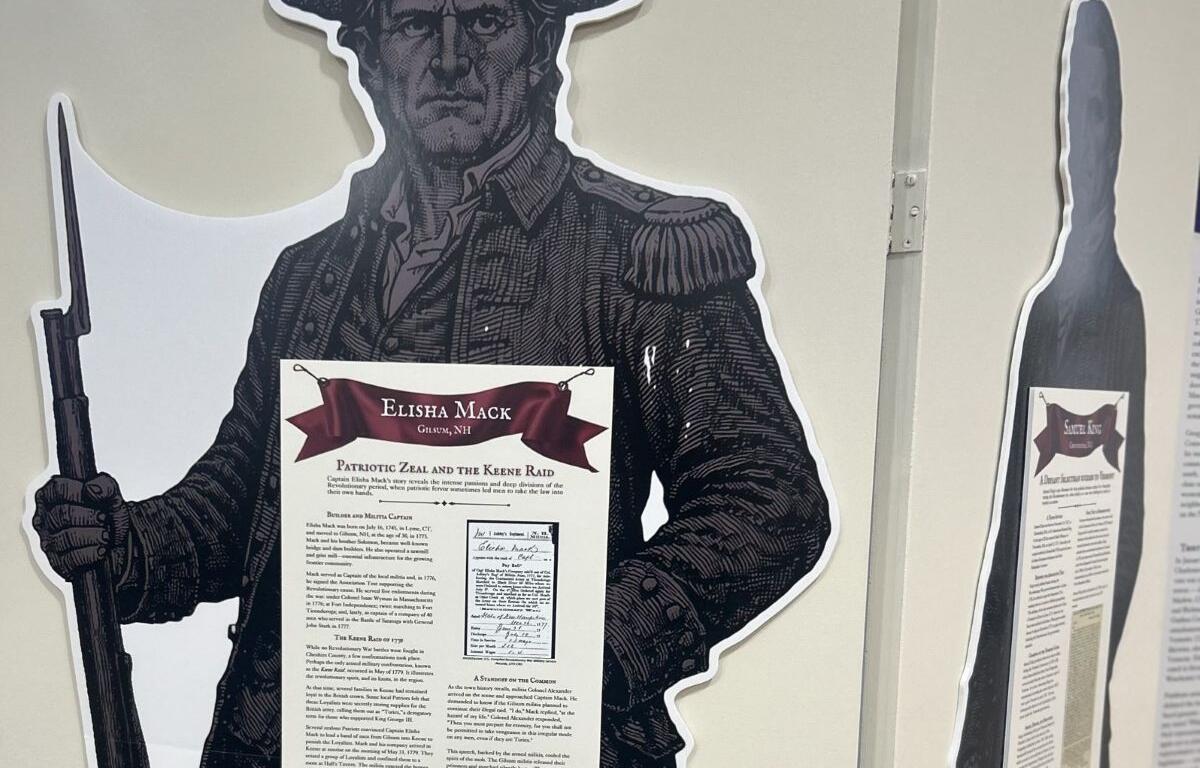
Through life-size silhouette figures, visitors are introduced to real Cheshire County residents whose decisions reflected the era’s tensions. Some supported independence and helped organize the war effort. Others resisted, revealing divisions that could split families and communities.
The post-war Vermont Controversy further underscores how questions of governance and identity persisted even after independence was declared.
Stories Built From Deep Research
What sets the exhibit apart is not just its storytelling—but the extraordinary amount of research behind it.
Organizers drew from a vast range of primary and secondary sources to reconstruct the lives of local residents. Military rolls, pension records, probate documents, town histories, genealogical archives, and early newspapers were all used to piece together individual stories. Materials from collections like FamilySearch, Ancestry databases, New Hampshire State Papers, and the Historical Society’s own archives were combined with scholarship from historians, local publications, and national institutions such as the National Park Service and American Battlefield Trust.
Each figure in the exhibit—from Indigenous soldier David Abraham to enslaved man-turned-soldier Tobias Cutler, from Loyalist figures to Patriot leaders—represents hours of research, cross-referencing, and interpretation.
The result is a collaborative effort involving historians, researchers, and contributors working across multiple disciplines to ensure accuracy and depth. Rather than relying on a single narrative, the exhibit reflects many voices and many sources, carefully woven together to present a fuller picture of the Revolutionary era in Cheshire County.
Stories Of Courage, Conflict and Contradiction
The exhibit also highlights the diverse—and often overlooked—people who shaped the Revolutionary era in southwest New Hampshire.
Indigenous and Black soldiers played active roles in the fight for independence. Enslaved individuals, such as Tobias Cutler of Rindge, pursued freedom through military service. Women managed households, sustained communities, and in some cases, made political statements—like Abigail Hale’s refusal to pay taxes without representation.
At the same time, Loyalists faced suspicion, punishment, or exile, illustrating how the Revolution was as much a civil conflict as it was a war for independence.
Programs That Bring History to Life
Complementing the exhibit is a wide-ranging lineup of talks, workshops, and hands-on programs that extend its themes beyond the gallery and into the community. These include Tavern Talks exploring Revolutionary-era figures and daily life, as well as lectures examining local divisions, such as “Patriots and Loyalists: Revolutionary Dissension in a Cheshire County Town.”
Other featured programs highlight underrepresented voices, including a June presentation on Black and Indigenous soldiers of the Revolution, offered in partnership with the Monadnock Center for History and Culture, which examines the experiences of men of color who fought for independence.
For younger audiences, hands-on opportunities such as summer history day camps introduce traditional skills like fiber arts, connecting children to the kinds of work that sustained households during the 18th century.
Organizers emphasize that these events are just a sampling of a much broader schedule tied to the exhibit and the Monadnock 250 commemoration. With numerous additional talks, tours, and educational programs planned throughout the season, visitors are encouraged to check the Historical Society of Cheshire County website for a full calendar of upcoming events, registration details, and newly-added programs.