


 Listen Live

KEENE, N.H. (MyKeeneNow) U.S. Sen. Jeanne Shaheen visited Keene Housing’s property at 657 Marlboro Road Thursday, using the planned rehabilitation of the four-unit building as a local example of the challenges facing New Hampshire’s housing market and the federal tools she says can help address them.
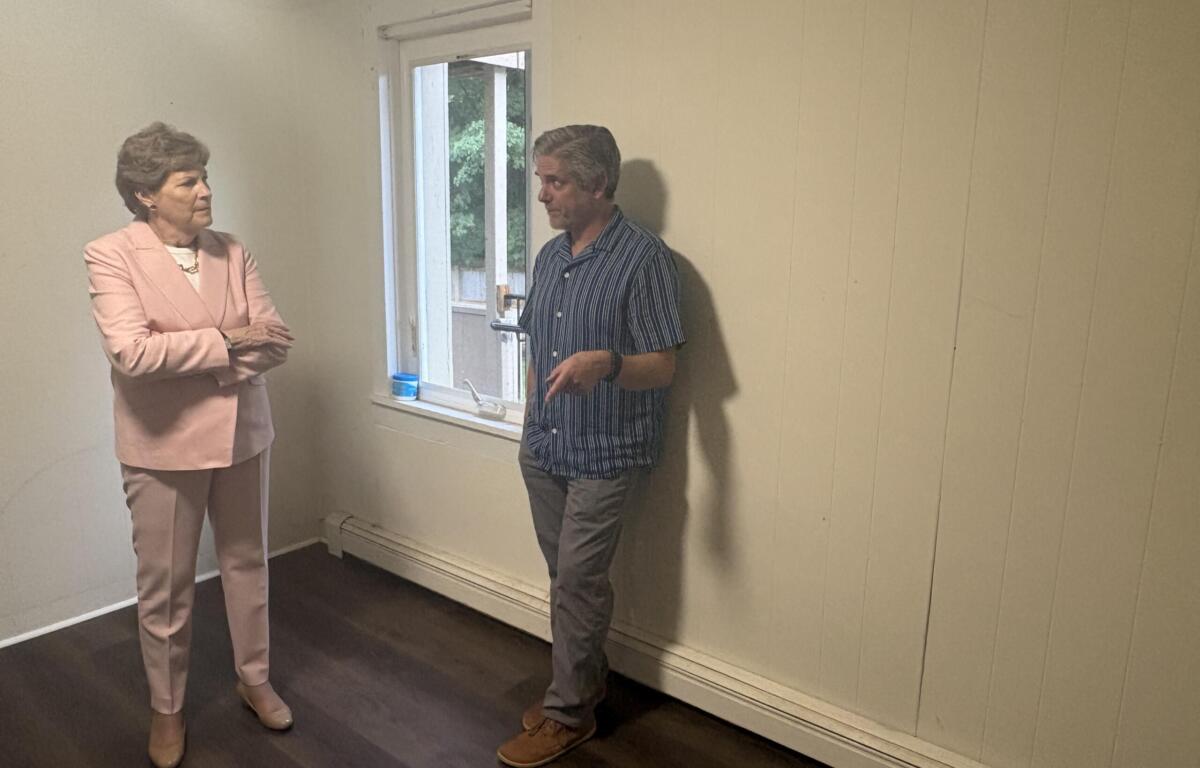
Shaheen toured the property with Keene Housing Executive Director Joshua Meehan and local officials as work is planned to transform the vacant, two-story building into four permanently affordable apartments.
The $750,000 rehabilitation is supported by a $500,000 Community Development Block Grant and $250,000 in funding from Monadnock Affordable Housing Corporation, the nonprofit affiliate of Keene Housing. The project will include full lead-hazard remediation, replacement of aging building systems, renovations to kitchens and bathrooms, and energy-efficiency improvements.
All four apartments — one one-bedroom and three two-bedroom units — will remain affordable to low- and moderate-income households. Each is supported through a project-based housing assistance contract, with residents paying 30 percent of their monthly income toward rent.
Shaheen said the project illustrates why federal housing programs and the bipartisan 21st Century Renewing Opportunity in the American Dream, or ROAD to Housing Act, are important.
“It was a bipartisan bill. It passed overwhelmingly in both houses with strong bipartisan support,” Shaheen said, “all designed to try and encourage housing construction and this kind of a project here in communities.”
The legislation includes three provisions Shaheen helped secure that she said are particularly relevant to New Hampshire: expanding support for manufactured housing and resident-owned communities, reducing bureaucratic duplication between the U.S. Department of Housing and Urban Development and the U.S. Department of Agriculture, and strengthening programs that support affordable housing development and preservation.
The senator said cutting through federal bureaucracy is particularly important for rural states such as New Hampshire.
“The third one that I think is really helpful, particularly, is that it would tie USDA and HUD together,” Shaheen said, noting that developers can otherwise be required to obtain approvals from both agencies for similar aspects of a project.
The legislation also extends authorization for a manufactured housing grant program, which Shaheen said can support resident-owned manufactured housing communities and provide another source of affordable housing.
The Keene project itself is being made possible in part through the Community Development Block Grant program, which Shaheen has supported. She said projects such as the Marlboro Road rehabilitation demonstrate how federal funding can be translated into housing preservation at the local level.
“This does a number of smaller things that address the bureaucratic obstacles to housing development,” Shaheen said. “It includes a number of grant programs that increase support for housing.”
A Severe Housing Shortage
The discussion also highlighted the scale of the housing shortage facing Keene.
Meehan said Keene Housing currently has approximately 2,400 to 2,500 households on its waiting list, including about 900 New Hampshire residents who receive preference.
The demand was underscored by the response to the recently developed Roosevelt East project on Washington Street. After Keene Housing contacted applicants seeking one- and two-bedroom apartments, Meehan said it received 365 applications for the 30-unit development.
He said the numbers demonstrate that even multiple developments of that size would not eliminate the region’s need.
Keene Housing has also begun expanding its regional role, including work in Jaffrey prompted in part by local business owners seeking additional workforce and affordable housing.
Shaheen said New Hampshire’s housing problems are especially acute.
“Housing is a huge issue, and in New Hampshire we are actually hit harder than the rest of the country,” she said.
Shaheen cited an average New Hampshire home price of more than $580,000 and said the state has roughly 2.5 months of for-sale housing inventory, compared with about five months in a healthier market. She also pointed to a rental vacancy rate of approximately 1%, compared with a roughly 5% rate considered healthy.
“Everything we can do to try and encourage both addressing the obstacles to building new housing, but also looking at funding and construction … because the reason we’ve got a problem is because we haven’t built enough housing in New Hampshire, and the same is true across the country,” Shaheen said.
Preserving Existing Housing
Meehan said Keene Housing has spent years concentrating on preserving and rehabilitating its existing housing stock, recognizing that renovating older buildings can often be less expensive than constructing new units.
The Marlboro Road property is part of a portfolio of older buildings acquired by Keene Housing in 2021. Many of the properties require extensive rehabilitation, including lead-paint remediation.
At 657 Marlboro Road, all four units are currently vacant while the work is completed. The rehabilitation will include complete lead abatement, new cabinets, countertops and fixtures, improvements to the building envelope, ENERGY STAR appliances, insulation, windows and doors, LED lighting and other efficiency measures.
Residents displaced by the work have been temporarily relocated within Keene Housing’s roughly 630-unit portfolio. Under Keene Housing’s Moving to Work flexibility, residents can either return to Marlboro Road once the project is complete or pursue other housing options.
Meehan said the flexibility has allowed Keene Housing to manage the rehabilitation while giving residents choices about where they live.
The property also represents a long-term preservation strategy. The project-based rental assistance will be renewed in successive 20-year terms, helping ensure the four apartments remain affordable for households with the greatest need.
Federal Flexibility
Meehan also raised concerns about how the ROAD to Housing Act could affect Keene Housing’s Moving to Work status.
Keene Housing has been one of the original Moving to Work agencies since 1999, giving it greater flexibility to tailor federal housing programs to local circumstances. Meehan said newer requirements associated with expanding the program could create significant reporting burdens, including requests for historical data that agencies were not previously required to collect.
He said Keene Housing is working with HUD and congressional staff to address the issue.
Shaheen offered to follow up through congressional oversight and the appropriations process.
Meehan also praised Shaheen and her staff for their responsiveness to Keene Housing.
“You and your staff have been the most responsive,” Meehan told Shaheen, describing the office as genuinely concerned about the people Keene Housing serves.
Shaheen, who has announced she will not seek another Senate term, said she and her staff will continue working on housing issues during her remaining time in office.
The Marlboro Road project, meanwhile, is expected to preserve four affordable homes while addressing significant health and safety issues in a building constructed in 1875.
For Shaheen, the project offered a tangible example of the broader challenge facing the state — and of the role federal funding, local housing agencies and changes in federal policy can play in addressing it.
“When we’ve got hundreds of people on wait lists for housing that’s adequate, we’ve got to figure out how to address that,” Shaheen said. “Housing, food, healthcare, education — those are four of the most basic needs that families have.”