


 Listen Live
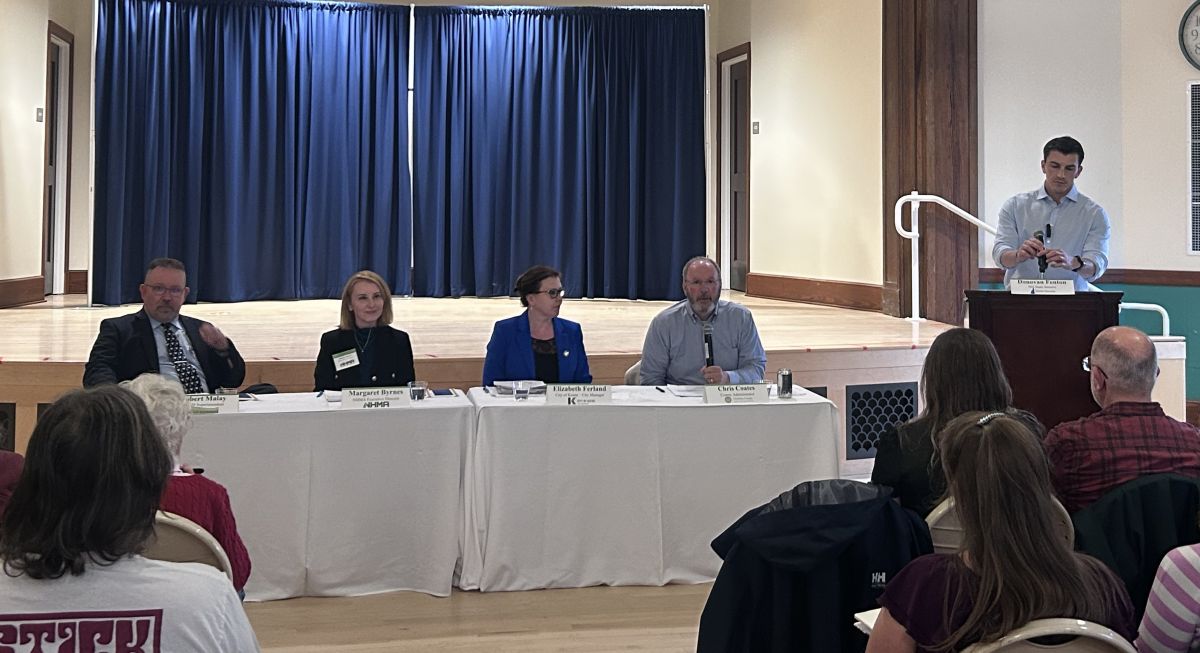

KEENE, N.H. (MyKeeneNow) Residents gathered Wednesday evening in Heberton Hall at the Keene Public Library for a public town hall discussion focused on rising property taxes, school funding shortfalls, and what panelists described as years of state cost shifting onto local communities.
The event was moderated by N.H. Senator Donovan Fenton and featured a panel that included Keene City Manager Elizabeth Ferland, Chris Coates, N.H. School Administrative Unit 29 Superintendent Robert Malay, and New Hampshire Municipal Association Executive Director Margaret Byrnes.
Fenton said the meeting was designed to help residents better understand how state budget decisions affect local tax rates and municipal services.
He pointed to the Keene School District’s proposed 3.4% budget increase for the 2026-27 school year, which is projected to result in roughly a 12% increase in the school portion of local property taxes because of declining state aid.
“That disconnect is a sign that the system is broken,” Fenton said, adding that the state has steadily shifted more financial responsibility onto municipalities and local taxpayers.
Throughout the evening, panelists repeatedly returned to the issue of “cost shifting,” describing it as a long-term pattern in which the state reduces or eliminates funding commitments while continuing to require municipalities, counties, and schools to provide services.
Cheshire County Administrator Chris Coates said the cumulative impact of those changes has created significant financial pressure for local governments.
“Over the years, what we’ve seen is that it’s gone away from that type of thought, and because of that, it’s putting incredible pressure on how we do business,” Coates said. “It’s about cost shifting — over $3 billion down to all of us.”
Coates highlighted changes to the New Hampshire Retirement System, noting that the state once covered 40% of local retirement costs before reducing its contribution to zero.
“That’s close to a $2 million forever burden” for Keene alone, Coates said.
New Hampshire Municipal Association Executive Director Margaret Byrnes said New Hampshire’s heavy reliance on local property taxes leaves municipalities vulnerable when state funding declines or revenue-sharing programs are reduced.
“When you have a revenue stream and it’s cut, that’s going to impact what you’re able to do locally, or it’s going to impact what you have to raise locally with property taxes,” Byrnes said.
Keene City Manager Elizabeth Ferland described cost shifting as a series of gradual financial changes over decades that have made municipal budgeting and long-term planning increasingly difficult.
She pointed to infrastructure concerns in Keene, including multiple municipally owned red-listed bridges and weight restrictions placed on the Spring Street and Beaver Street bridges that have affected school buses, emergency vehicles, and commercial deliveries.
“The projects become more expensive the longer they are delayed,” Ferland said.
The discussion also focused heavily on education funding and state adequacy aid.
Keene School District Superintendent Robert Malay said reductions in special education reimbursements and retirement support have forced local districts to absorb millions of dollars in additional costs.
“At one time, we were getting 80%” reimbursement for catastrophic special education costs, Malay said. “Now, if we’re lucky, we’re seeing 67 to 68 cents to the dollar.”
Malay also criticized differences between public school adequacy funding and Education Freedom Account funding levels, saying the state currently provides more funding per student in some alternative education settings than in traditional public schools.
“Our public schools are some of the most regulated structures we have in the state,” Malay said. “We don’t have the right to refuse service to anyone who comes to our door.”
A major portion of the discussion focused on what residents can do to reduce long-term property tax pressure.
Byrnes said one option is for communities to reduce local spending by delaying projects, limiting services, or postponing maintenance, but she cautioned that those decisions often create larger expenses later.
“Every project delayed is more expensive later on,” Byrnes said, noting that inflation and deteriorating infrastructure can significantly increase future costs.
Instead, panelists emphasized the importance of sustained public involvement and state-level advocacy.
“One way of property tax relief is more funding from the state level, back down to cities, towns, county, school districts, etc.,” Byrnes said. “The other piece to it is another way to offset property taxes is to give local governments more ways to raise money locally that is not property taxes.”
Ferland encouraged municipalities and residents to become more active in legislative discussions surrounding education funding and municipal aid.
“Being active in the legislative process, I think, would be helpful,” Ferland said. “I feel that towns and cities need to band together on the school funding issue.”
Panelists urged residents to monitor legislation affecting municipal and school funding, testify before lawmakers, contact elected officials, and support organizations working to combat unfunded mandates and state downshifting.
Malay also encouraged residents to closely evaluate candidates’ positions on education funding and municipal aid when voting.
“Make sure you’re paying attention in November,” Malay said. “Really analyze what they stand for, what they believe in, and what they’re going to do to represent you.”
Fenton said continued public engagement would be necessary if communities hope to see meaningful long-term property tax relief.
Audience members submitted written questions throughout the evening, but Fenton ultimately chose to conclude the meeting and have panelists respond to the remaining questions afterward.
“I think it’s really important that we can come together in a setting like this,” Fenton said. “Stay informed, ask questions. There’s a lot of misinformation out there, a lot of confusion about politics and perspective.”